Eduqas · GCSE · English Language
Section A (20%) – Reading
This study guide demystifies Section A (Reading) of the GCSE English Language exam. It focuses on the core skills required to secure high marks: identifying information, analysing language and structure, comparing viewpoints, and evaluating critically.
- 6 min read
- 3 worked examples
- 5 practice questions
- 8 key terms
Study Notes
Overview
Section A of your GCSE English Language exam assesses your reading skills. You will be presented with unseen texts—extracts from fiction or non-fiction that you haven't studied before. The exam does not test your memory of specific books; it tests your ability to read intelligently, analyse precisely, and respond with insight under timed conditions.
Every question is designed to test a specific Assessment Objective (AO). By understanding exactly what each AO requires, you can structure your answers to guarantee you hit the marking criteria. Examiners are looking for candidates who can move beyond basic comprehension to detailed, perceptive analysis of how a writer achieves effects.
Listen to our comprehensive 10-minute audio guide for a detailed walkthrough of exam strategies and common pitfalls:
Reading Skills
Identifying Information & Ideas (AO1)
This is your foundation skill. AO1 requires you to identify and interpret explicit and implicit information and ideas.
- Explicit Information: Details that are directly stated in the text (e.g., "The door was painted red").
- Implicit Information: Details that are suggested or implied, requiring you to 'read between the lines' (e.g., "The door's paint was peeling and the handle hung loose," implying neglect or poverty).
When asked to "List four things you learn about...", keep your answers brief and factual. Do not waste time writing full analytical paragraphs for these low-mark questions.
Analysing Language (AO2)
This is where many marks are won or lost. AO2 asks you to explain, comment on, and analyse how writers use language to achieve effects and influence readers.
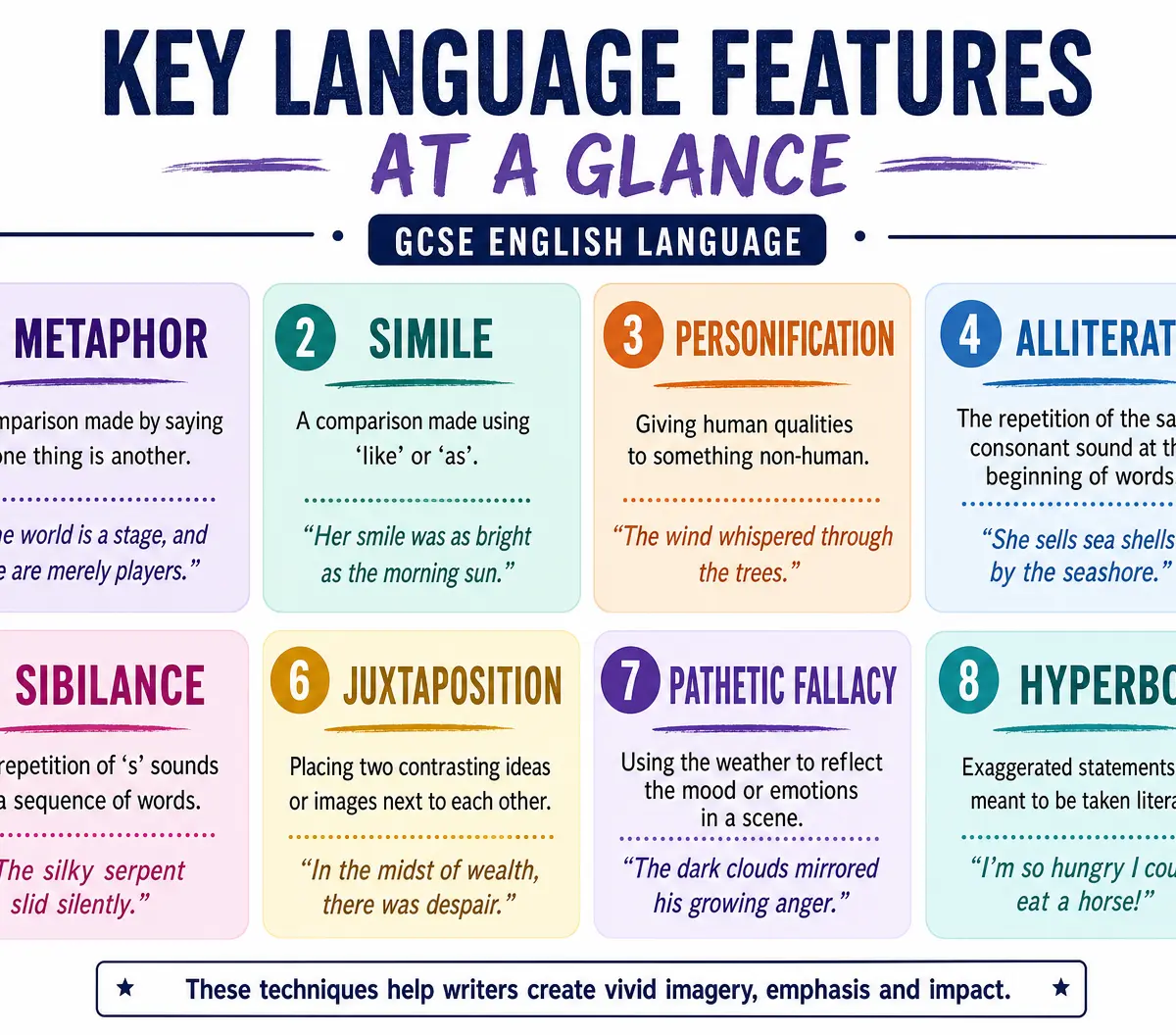
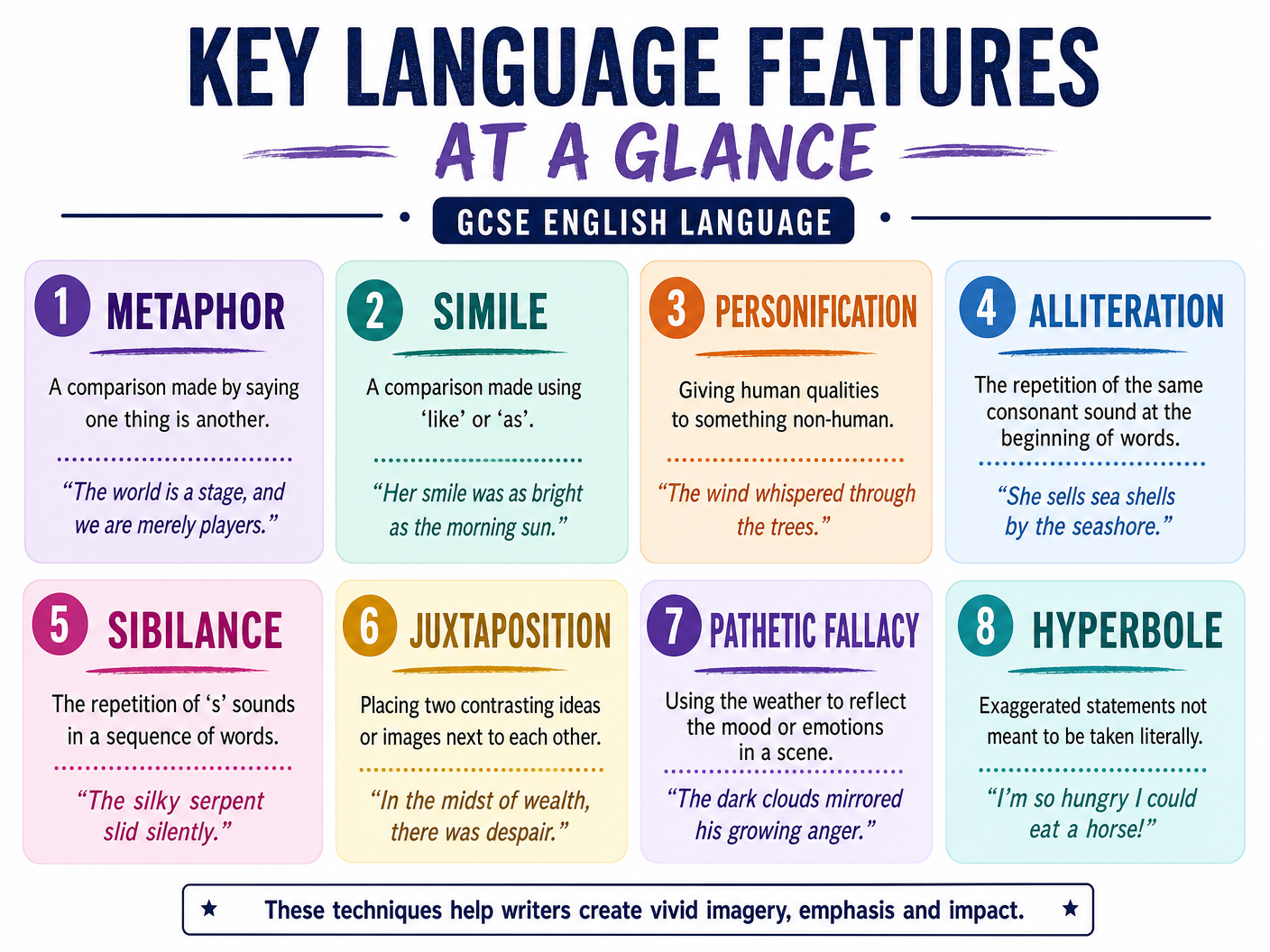
The crucial difference between a weak and a strong answer is the move from feature-spotting to effect analysis. Stating "The writer uses a simile" earns very little credit. Stating "The writer uses a simile to create a sense of overwhelming isolation, making the reader empathise with the protagonist's vulnerability" earns high marks.
The PEAL Framework
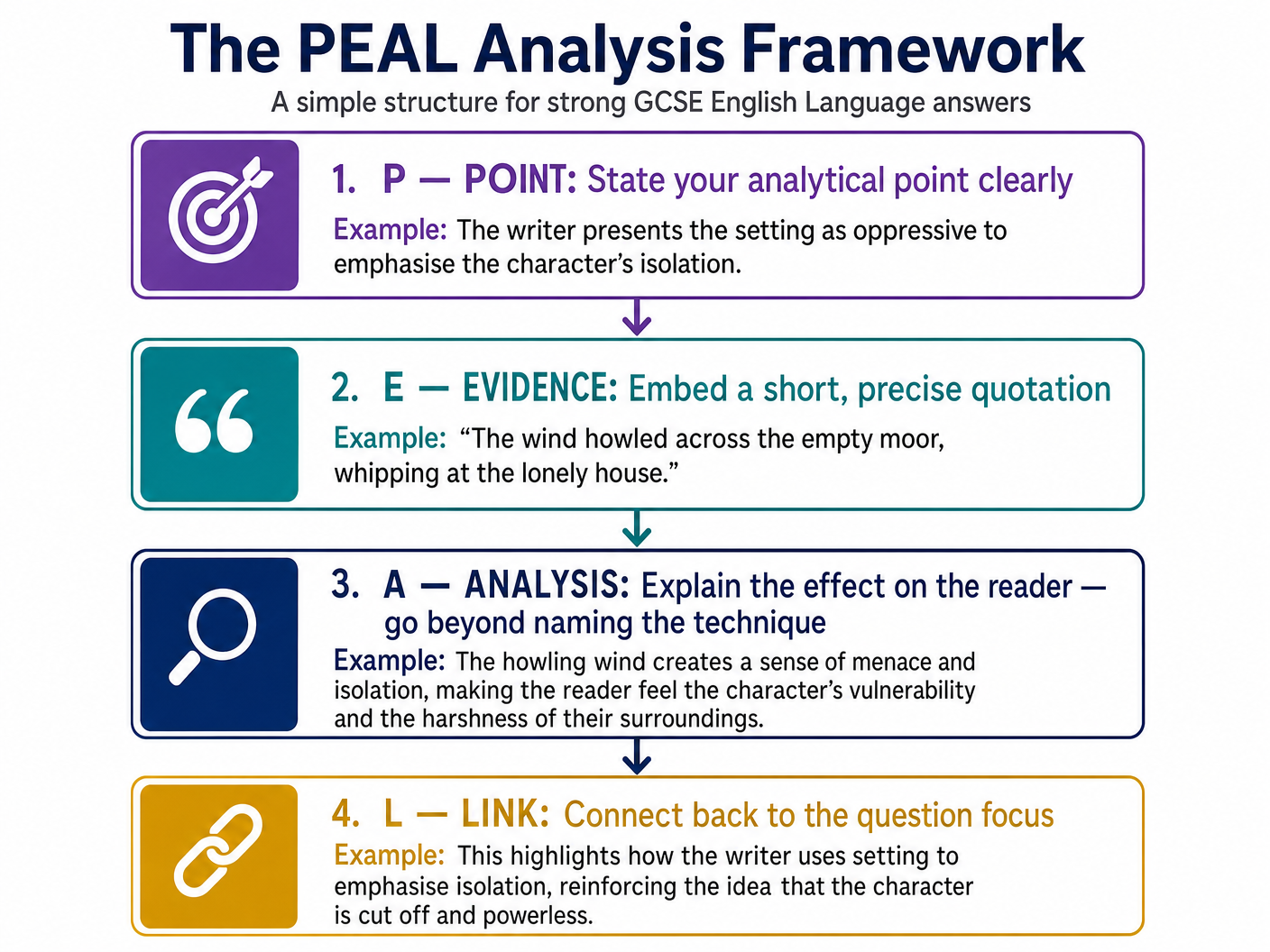
To ensure your analytical paragraphs are structured effectively, always use the PEAL framework:
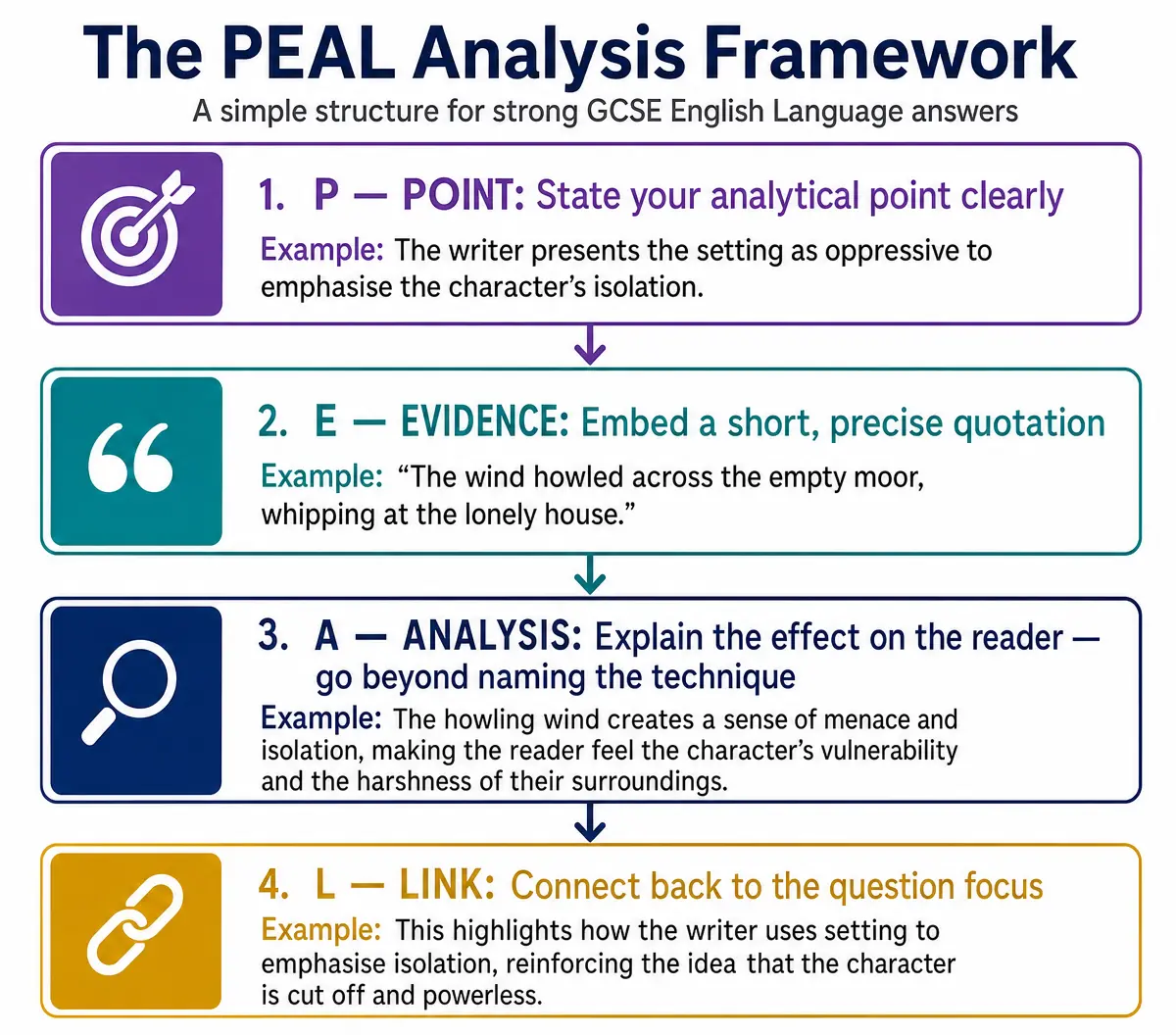
- Point: State your analytical point clearly.
- Evidence: Embed a short, precise quotation.
- Analysis: Explain the effect on the reader—go beyond naming the technique.
- Link: Connect back to the question focus.
Analysing Structure (AO2)
While language focuses on words, structure focuses on how the text is put together. Examiners reward candidates who can explain why a writer chose a particular structural feature at a specific moment.
Key structural features to look for:
- Openings: Does it start in medias res (in the middle of the action) to create immediate tension?
- Shifts in Focus: Does the writer move from the setting to a character, or from the past to the present?
- Narrative Perspective: Who is telling the story? Is it a limited first-person view, or an omniscient third-person narrator?
- Sentence Length Variation: Are short, punchy sentences used to build tension or speed up the pace? Are long, complex sentences used for detailed description?
- Paragraph Structure: Are single-sentence paragraphs used for dramatic impact?
- Cyclical Structure: Does the text end where it began, suggesting a lack of change or inescapable circumstances?
- Foreshadowing/Flashbacks: How does the writer manipulate time to build suspense or provide context?
Evaluating Critically (AO4)
AO4 requires you to evaluate texts critically and support this with appropriate textual references. This is where you give your informed opinion on the effectiveness of a text.
You might be given a statement (e.g., "A student said, 'The writer successfully creates a terrifying atmosphere.' To what extent do you agree?").
Your job is to form a judgement. A strong response will:
- State a clear opinion (e.g., "I strongly agree that...").
- Select the best evidence from the text to support this view.
- Analyse the methods the writer uses to create the effect.
- Explain why those methods are effective in achieving the stated outcome.
Comparing Writers' Viewpoints (AO3)
AO3 asks you to compare writers' ideas and perspectives, as well as how these are conveyed, across two or more texts.
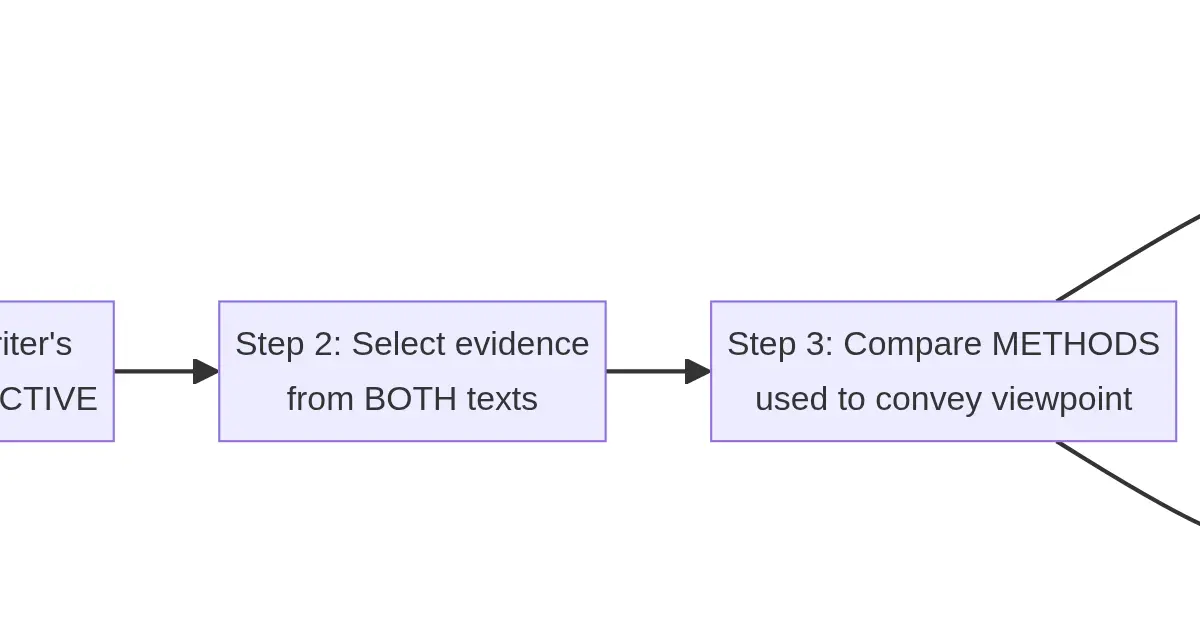
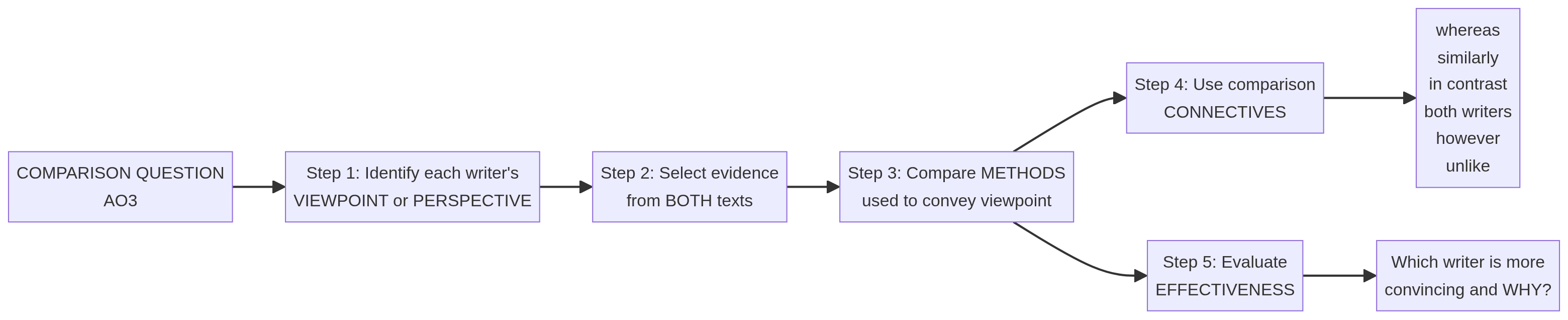
A strong comparison weaves the texts together rather than treating them in isolation. You must:
- Identify the differing (or similar) viewpoints of the writers.
- Compare the methods (language, structure, tone) they use to convey those viewpoints.
- Evaluate which is more effective or how they differ in impact.
- Use comparative connectives constantly (e.g., whereas, similarly, in contrast, on the other hand, conversely).
Writing Skills
While Section A focuses on Reading, the skills are intrinsically linked to Section B (Writing). The techniques you analyse in reading are the very techniques you should deploy in your own writing.
Creative Writing
- Show, Don't Tell: Instead of saying "He was angry," describe his clenched fists and flushed face.
- Sensory Description: Engage the reader by describing sights, sounds, smells, textures, and tastes.
- Varied Sentence Structures: Use a mix of simple, compound, and complex sentences for rhythm and impact.
- The One-Scene Rule: Focus on a single, well-developed scene or moment rather than trying to write an entire novel in 45 minutes.
Transactional/Non-Fiction Writing
- Purpose, Form, Audience: Always adapt your tone and register to match why you are writing, what format you are using (letter, speech, article), and who you are writing to.
- Persuasive Techniques: Use the AFOREST techniques (see Memory Hooks) to build a compelling argument.
Technical Accuracy (SPaG)
Spelling, Punctuation, and Grammar (SPaG) account for a significant portion of your writing marks. Examiners look for:
- Ambitious Vocabulary: Use precise, sophisticated words instead of basic ones.
- Advanced Punctuation: Demonstrate control over semicolons, colons, dashes, and parenthetical commas.
- Paragraph Cohesion: Use discourse markers (e.g., furthermore, consequently, nevertheless) to link paragraphs smoothly.
Visual Resources
4 diagrams and illustrations
Interactive Diagrams
2 interactive diagrams to visualise key concepts
Conceptual Flow Outline
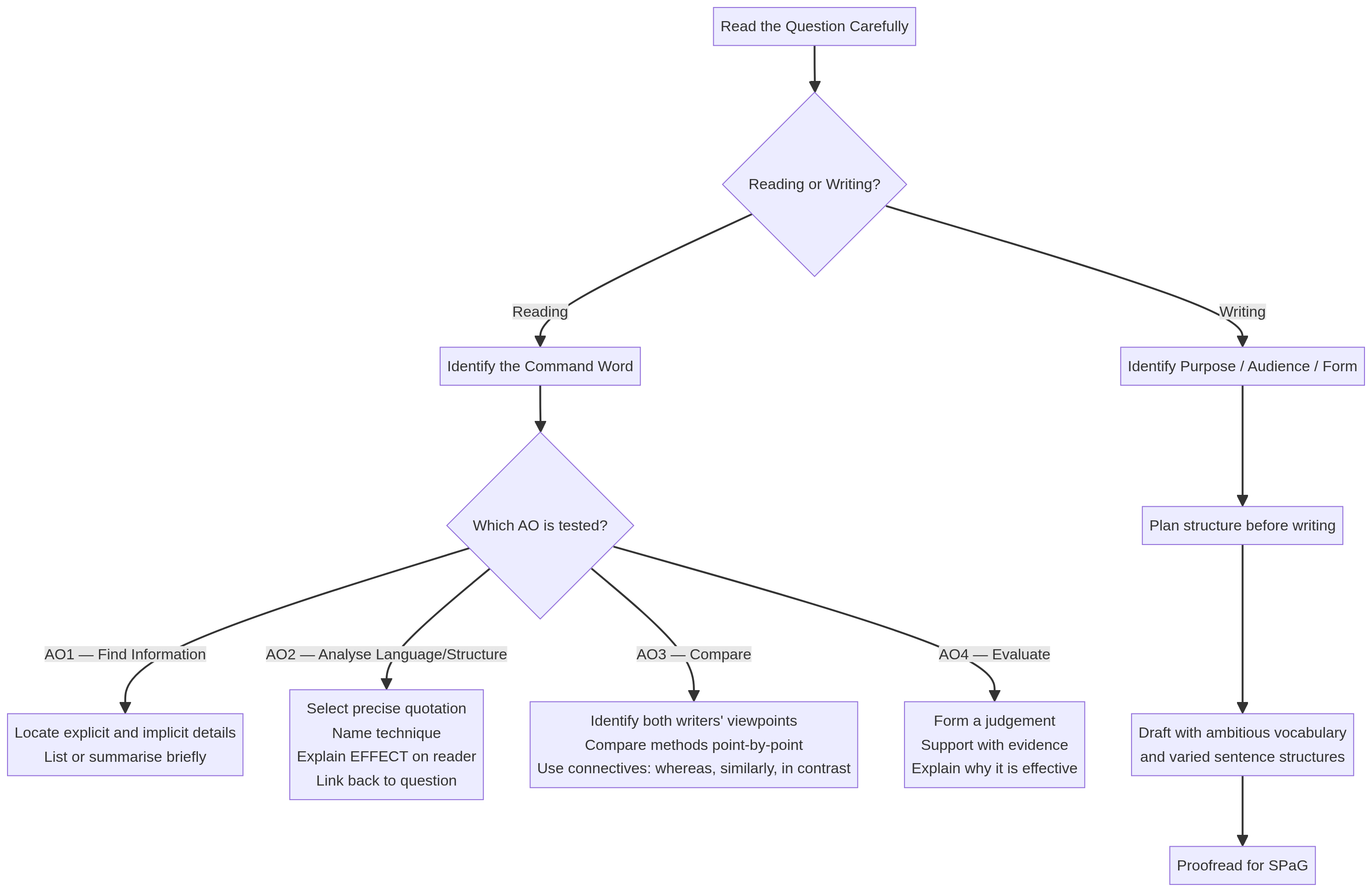
English Language Exam Approach Flowchart
Conceptual Flow Outline
AO3 Comparison Framework
Worked Examples
3 worked examples — open one to explore the question and available guidance.
Practice Questions
Test your understanding — click to reveal model answers
Read lines 5-12. List four things you learn about the weather.
Hint: Look only at lines 5-12. Find explicit facts. Do not write long sentences.
Read lines 1-15. How does the writer use language to describe the tension in the room?
Hint: Identify a technique, embed a short quote, and explain how it makes the reader feel the tension.
Read lines 20-35. How does the writer structure the text to interest the reader?
Hint: Look for shifts in focus, sentence lengths, or how the passage begins and ends.
A student said: 'The writer's description of the city makes it seem like a magical, welcoming place.' To what extent do you agree?
Hint: State your opinion clearly. Find the best evidence to support it. Analyse *how* the writer creates that impression.
Compare how the writers convey their different attitudes towards travel in Source A and Source B.
Hint: Identify the attitude in A. Identify the attitude in B. Compare the methods they use. Use connectives.